Trenchless sewer repair
Lining and bursting are sewer contractor’s methods, and you won’t find them on a plumber’s truck. Nothing gets quoted until a camera has seen your line.
The three methods
Each one saves a yard, a driveway or a set of steps from a full trench. They solve different problems.
- CIPP lining: a resin-soaked liner is pulled into the old pipe and cured there, forming a new pipe inside it
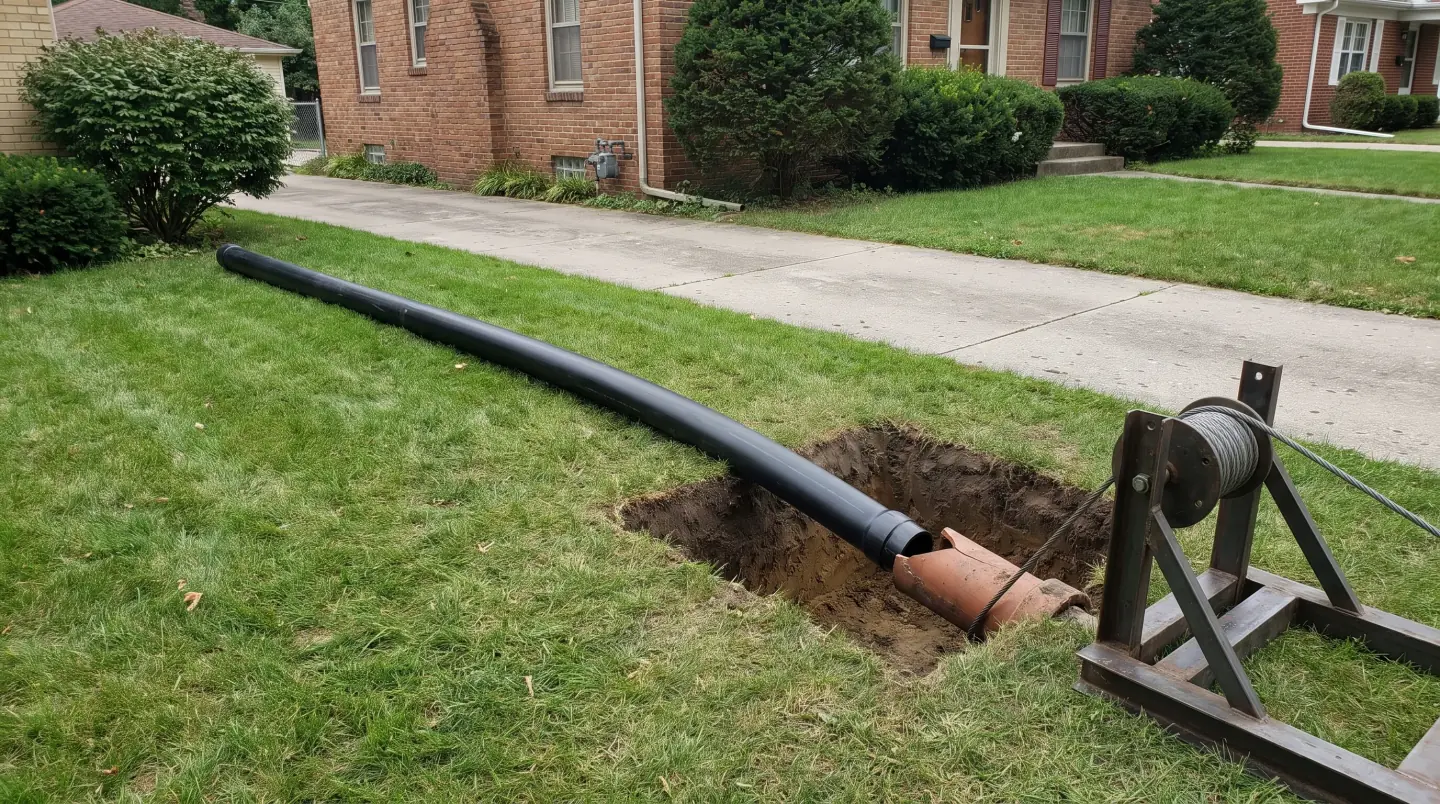
- Pipe bursting: a head pulled through the old line breaks it outward while new pipe follows behind
- Trenchless spot repair: a short liner sealed over one bad section
Why the camera comes first
Plenty of lines aren’t candidates, and it’s better to learn that before signing anything. NASSCO, the trade group for pipeline rehabilitation, says a joint offset cutting the pipe’s cross-section by 40 percent or more needs fixing before a liner goes in.
A liner also keeps the line and grade it’s given. A belly that holds water today will hold water with a liner in it. Collapsed sections stop a liner altogether, and those sections mean some digging anyway.
What it still takes
“Trenchless” doesn’t mean no holes. Lining needs access at one or both ends, and bursting usually needs a pit at each end. The line has to be cleaned first as well. What you’re saving is everything between those points, which is often the part with the landscaping, the driveway or the old tree on it.
If your line doesn’t qualify
Then you hear it, with the footage in hand. Conventional excavation is the honest answer for a line with bellies or a collapse, and it lets the grade be corrected too. Spot repairs may cover the rest.
Related work
Trenchless Sewer Repair across 77 Illinois towns, including Granite City, Collinsville, East St. Louis, Edwardsville, Alton, O'Fallon, Godfrey, Belleville.
Answers
Trenchless Sewer Repair: common questions
What is trenchless sewer repair?
It covers methods that renew a buried sewer from access points instead of digging its whole length. CIPP lining cures a new pipe inside the old one, pipe bursting breaks the old pipe while pulling in a new one, and spot repair seals a single bad section. Each has limits.
Can trenchless sewer repair fix a belly?
Lining can’t, because a liner follows the path of the existing pipe, low spot included. Water and solids will still gather there. Pipe bursting can sometimes improve a mild dip, though a real belly is usually dug up and regraded. A camera run shows how deep the low spot is.
How long does trenchless sewer repair last?
A properly installed liner is built for decades of service, though real results depend on the installation and on the pipe around it. A line that was cleaned or prepared poorly can fail far sooner. Ask any contractor to put the warranty terms in writing before you sign.
Does trenchless sewer repair cost less than digging?
Sometimes it is, particularly when the line runs under a driveway, patio or mature trees, since restoration drives up the cost of a trench. On a short shallow run under open lawn, digging can cost less. We don’t post prices, so compare the two on your own line with your footage.
How do I know if my line can be lined instead of replaced?
A camera inspection decides it. The pipe needs to hold its basic shape, with no collapse, no serious offset and no belly deep enough to matter. Orangeburg that has flattened generally doesn’t qualify. You keep the video from the inspection, so you can get a second opinion if you’d like one.