
New sewer line installation
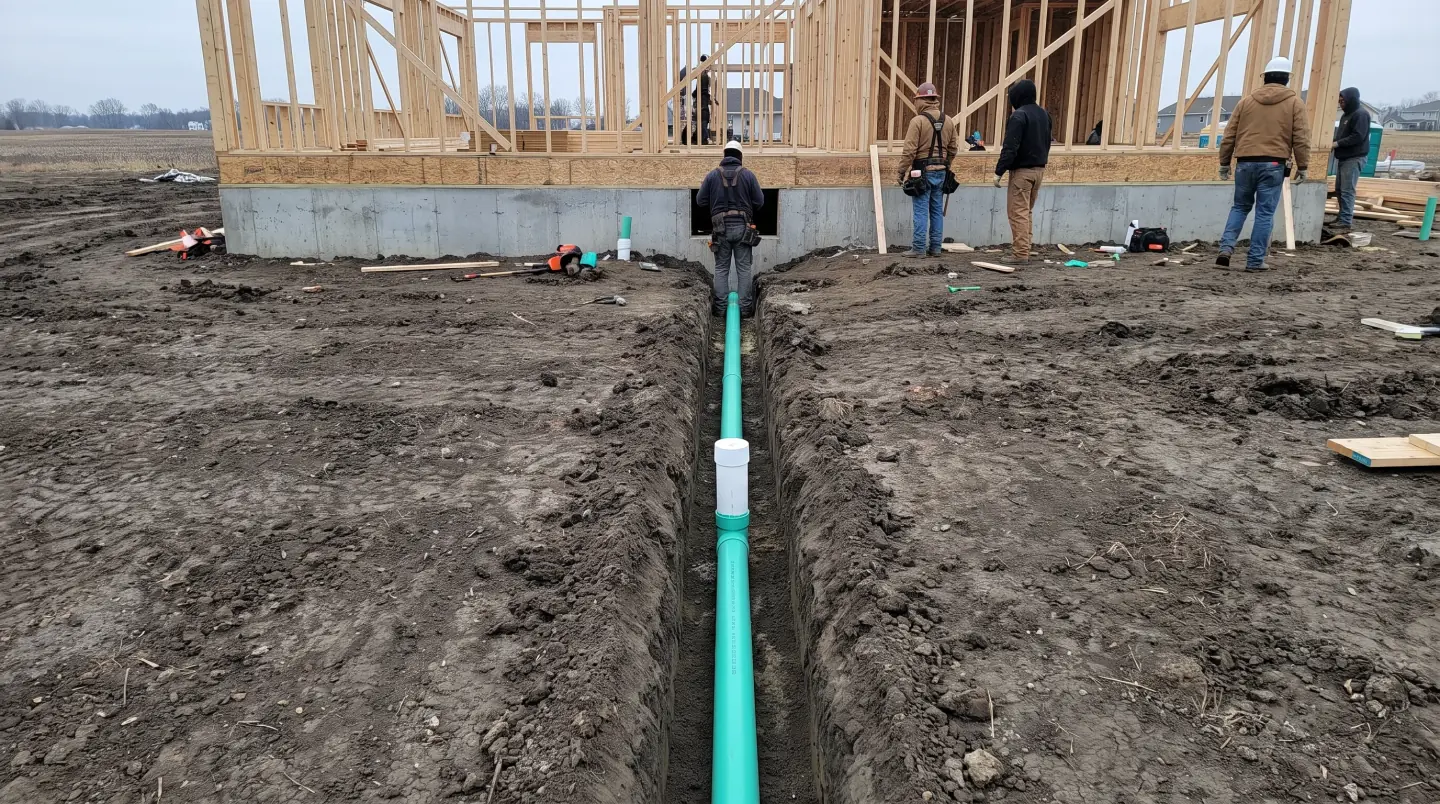
Your plumber’s work ends five feet outside the foundation. The new line from there to the main is ours.
When a new line goes in
New houses and buildings, of course. Also additions and remodels that bring new bathrooms or a new kitchen, and older properties where the existing line is undersized for what now drains into it.
Who does which part
Illinois law splits the system at a fixed point. Inside the walls and out to 5 feet beyond the foundation is the building drain, and it’s plumbing. From there to the public sewer or a private system is the building sewer. On most projects a plumber roughs in the first part and we take over at the second, so the two of us need to agree on where the pipe leaves the wall and how deep.
What the code asks for
State rules set the floor. The Illinois Plumbing Code calls for clean-outs at set spacing, 50 feet apart on 4-inch line and smaller, plus one at the foundation. Its grade section sets the minimum fall.
Towns add their own requirements on top. Maryville publishes lateral requirements, and O’Fallon charges sewer tap fees, so the local office comes into the plan early. Since January 1, 2026, a new nonconductive lateral has to be locatable from the surface as well.
Before the digging starts
State law requires notice through JULIE at least 2 days and no more than 10 days before excavation, and those days leave out weekends, JULIE holidays and the day of the call itself. On a new build, get that into the schedule along with the trenching.
Related work
Sewer Line Installation across 77 Illinois towns, including Granite City, Collinsville, East St. Louis, Edwardsville, Alton, O'Fallon, Godfrey, Belleville.
Answers
Sewer Line Installation: common questions
How deep does a sewer line need to be in Illinois?
No single depth fits every lot, because it has to come out of the foundation at a workable height and still fall steadily to the main. Slope governs the design, along with local frost and connection rules. Your town’s building office and the sewer provider’s connection point set the real numbers.
What slope does a new sewer line need?
Illinois sets a minimum of one-eighth inch per foot for drain pipe larger than 3 inches and smaller than 8. Local rules can ask for more. Too little fall lets solids settle, and that is why slope gets checked before the trench is backfilled and the yard is put back.
How much does a new sewer line cost?
We don’t post prices, since length, depth, soil, surface restoration and local tap fees all change the total. Fees are set by the town or sewer provider, and they sit outside any contractor’s control. Give us the address and plans, and a representative will talk through an estimate.
Do I need a permit to install a sewer line?
In most towns, yes, and the details belong to the local building or public works office. Some publish lateral requirements and tap fees online. Ask before work starts, since a sewer connection usually has to be inspected before it is covered, and reopening a trench costs real money.
Can a sewer line be too small for an addition?
Yes. A line sized for a small older house can be undersized once new bathrooms or a second kitchen drain into it. Code sizes pipe by the fixtures it serves. If your remodel adds fixtures, have someone check the existing line’s size and condition before closing up the walls.