
Sewer line repair
Past five feet outside your foundation, Illinois law stops calling this plumbing. It’s what we do.
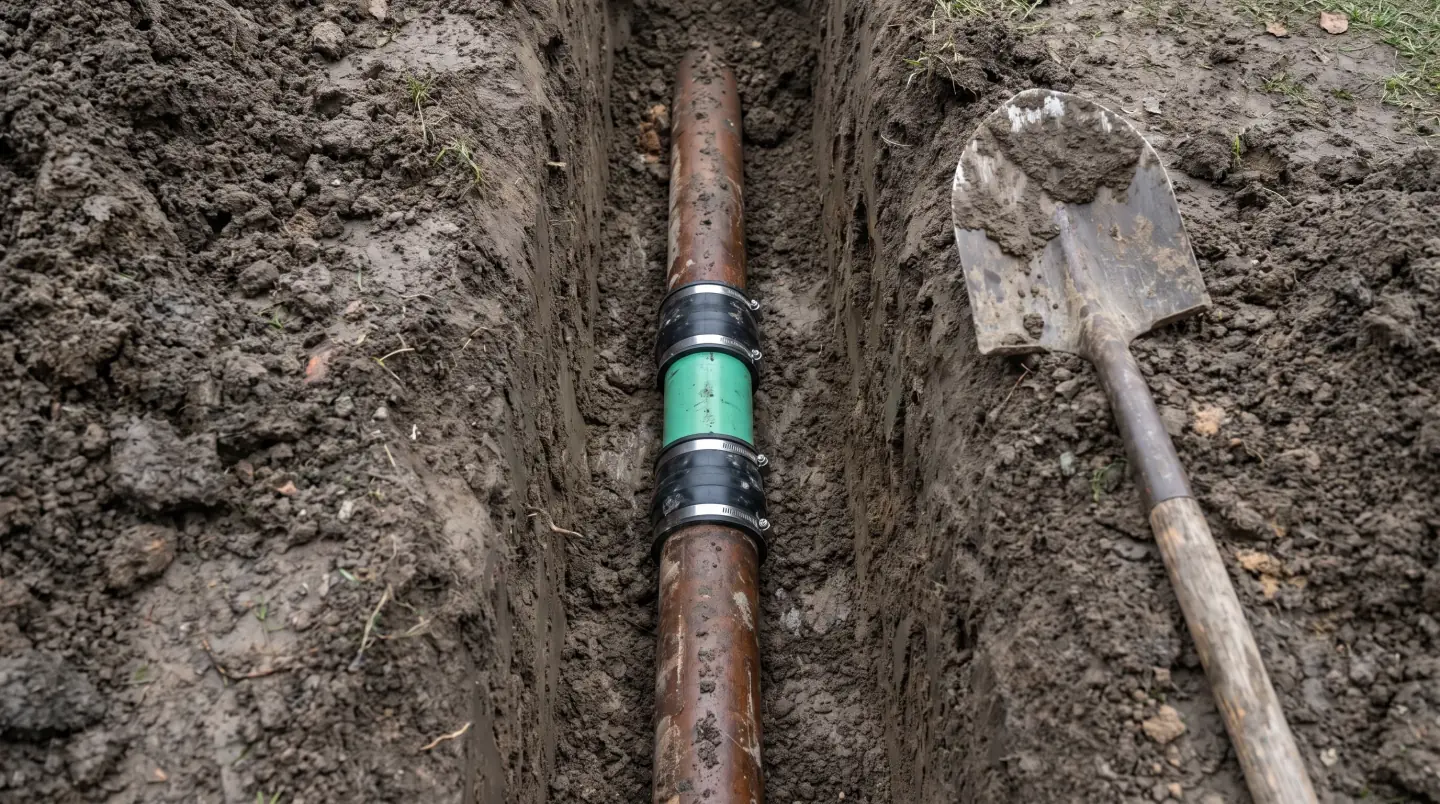
What the repairs are
Most old laterals don’t fail along their whole length. They fail at a joint, at a fitting, or where a root found a way in, and the pipe on either side can be fine.
- Spot repairs to a cracked or broken section
- Root removal
- Repairs at joints and fittings where the pipe has separated or shifted
- Partial replacement of a short run
- Excavation to reach the damage
Why joints go first
Before World War II, clay sewer pipe was typically joined with oakum and cement mortar. The National Clay Pipe Institute describes those joints as rigid and poor at taking earth movement, and root penetration is on its list of the troubles later joint designs set out to solve. In towns like Alton and Wood River, where the median house dates to the early 1950s, plenty of that pipe is still in service.
Repair or replace
The camera settles this. One bad joint on otherwise round, clean pipe calls for a spot repair. Cracks every few feet, low spots holding water, or Orangeburg that’s losing its shape mean a patch will just move the next backup somewhere else on the line, and replacing the run makes more sense. You see the same footage we do.
Whose pipe is it
Usually yours, farther out than people expect. Granite City says the owner maintains the lateral all the way to the main, even under the street, though that page may predate Illinois American Water’s purchase of the system. O’Fallon says its responsibility begins at its own main. Rules differ by town and by sewer owner, so check before assuming, and our town pages note what we could confirm.
Related work
Sewer Line Repair across 77 Illinois towns, including Granite City, Collinsville, East St. Louis, Edwardsville, Alton, O'Fallon, Godfrey, Belleville.
Answers
Sewer Line Repair: common questions
What are the signs of a broken sewer line?
Repeat backups, sewage odor, and a soggy or sunken patch along the line’s path are the usual signs. Gurgling drains and a line that clogs soon after each cleaning add to the case. None of them proves a break on its own, and a camera run shows where the damage is.
What does sewer line repair cost?
It depends on depth, where the damage sits, and what is above it, so we don’t list a price. A shallow break under lawn is a different job from one under a driveway. Camera footage usually comes first, and it lets a representative talk through an estimate based on what it shows.
Does homeowners insurance cover sewer line repair?
Often it does not, so read your policy. Standard homeowners coverage commonly leaves out wear on buried lines, and separate service-line endorsements are sold for this. Backups have a coverage question of their own. Your agent can say exactly what your policy pays for and what it excludes.
Can roots in a sewer line be fixed without digging?
Often they can be cleared without digging, using cutting heads or a jetter, but clearing doesn’t close the joint they came through. They will return until that joint is repaired or the pipe is lined. A camera shows whether the pipe around the roots is sound enough for lining.
Who is responsible for the sewer line under the street in Illinois?
That varies by town and by whoever owns the sewer system. Granite City’s page puts the lateral on the owner all the way to the main, and O’Fallon says its own duty starts at the main. Several local systems have changed hands lately, so ask your sewer provider before you hire anyone.
Do plumbers fix sewer lines in Illinois?
They may, and some do. Illinois law says building sewers are not plumbing, but it also says a licensed plumber is not barred from working on them. A company that works only underground is simply the more direct call for a line that runs beyond the foundation.